
Updated on 10/06/2020: I initially wrote this blog post on 07/06/2016. Yeah, that was about four years ago. I took some time to explore how I could earn money online from home in Saudi Arabia. I also experienced some of the challenges that a person living in Saudi Arabia could come across when getting into this type of business.
If you're looking forward to making money from home in Saudi Arabia, then you've come to the right place. I'll describe some make money online opportunities that you can easily start if you are a resident of Saudi Arabia.
Below are some methods, which I tried myself and which I will cover in this blog post:
- Liyeplimal Cryptocurrency MLM System
- Affiliate Marketing
- Ebook Publishing
- Mystery Shopping
- Direct Selling
- Online Services
Note that you can try any of these online business models, whether you live in the UAE, India, Egypt, Nigeria, or Pakistan, etc.
Two years ago, I was more successful with ebook publishing than affiliate marketing mainly because I invested more time in the former. However, in early 2019, I made it a point to focus on affiliate marketing, and I'll share my experience below. I also became interested in cryptocurrency and it turned out more profitable than I had imagined.
In fact, it was easier to break into cryptocurrency investment than affiliate marketing and ebook publishing, which is why I'll start with it in this post.
Liyeplimal Cryptocurrency MLM System
It took me close to one year to do my research and join Liyeplimal. The main reason that prompted me to invest in a Liyeplimal pack was that my elder sister had been a member for a little over two years, and she had made six figures (in USD) annually with the system.If this is new to you, Liyeplimal is a system that gives people the opportunity to invest in cryptocurrency packs (with the prices ranging from $100 to $100,000). When you buy a pack, the company purchases and resells cryptocurrency and pays you part of the profit.
Once you buy a pack, the company sends your first payment seven days after the date you bought the pack and continues paying you every week for a period of one year. You can buy several packs if you wish.
The images below show you the different packs and the amount you'll get paid weekly.


For example, if you buy a pack of $800, you get paid $29.23 every week for 52 weeks. At the end of one year, you'll get paid a total of $1520.
Here's a quick video that I made to explain the Liyeplimal opportunity.
My Experience with Liyeplimal
I bought a $1600 Liyeplimal pack (also called the Malabo package). I get paid $61.53 every week, which means I'll get paid a total of $3200 after 52 weeks (one year). The company consistently sends my weekly payments (see the image below), and I can withdraw the money via my chosen payment method.

Withdrawals are made from the 1st to the 23rd of each month (until midday on the 23rd). People living in West and South Africa have multiple payment options. For those living in Saudi Arabia, you have two main methods. The easiest way for you to withdraw your money is to use the Liyeplimal Visa card, which you can order by contacting an admin of the Saudi team. The Liyeplimal Visa card works worldwide and you can use it to shop online or withdraw money from an ATM.
Another method to withdraw money on Liyeplimal is by sending the equivalent amount in Bitcoin to your cryptocurrency wallet. You can HODL your Bitcoin for as long as you wish or sell it in exchange for Saudi riyals.
Another method to withdraw money on Liyeplimal is by sending the equivalent amount in Bitcoin to your cryptocurrency wallet. You can HODL your Bitcoin for as long as you wish or sell it in exchange for Saudi riyals.
How Else Can You Make Money with Liyeplimal?
Liyeplimal follows a multilevel marketing system. So, you can also make money by referring people to the system.
Here's how you get compensated:
Level 1: You get paid 6% commission when your first generation referrals (i.e., members that you directly referred) buy a pack.
Level 2: You get paid 6% commission when your first generation referrals buy a pack. You earn 2% on purchases made by second generation referrals (i.e., persons who were referred to the system by your direct referrals).
Level 3: You get paid 6% commission when your first generation referrals buy a pack, 2% when second generation referrals buy a pack, and 1% when third generation referrals buy a pack.
Level 4: You get paid 6% commission when your first generation referrals buy a pack, 2% when second generation referrals buy a pack, 1% when third generation referrals buy a pack, and 1% when fourth generation referrals buy a pack.
Level 5: You get paid 6% commission when your first generation referrals buy a pack, 2% when second generation referrals buy a pack, 1% when third generation referrals buy a pack, 1% when fourth generation referrals buy a pack, and 2% when fifth generation referrals buy a pack.
The third method of making money with Liyeplimal is by selling USD in exchange for Saudi riyals or another fiat currency. However, you can only do this with other Liyeplimal members. That alone is a blog post in itself, and I'll get to that eventually.
Here's how you get compensated:
Level 1: You get paid 6% commission when your first generation referrals (i.e., members that you directly referred) buy a pack.
Level 2: You get paid 6% commission when your first generation referrals buy a pack. You earn 2% on purchases made by second generation referrals (i.e., persons who were referred to the system by your direct referrals).
Level 3: You get paid 6% commission when your first generation referrals buy a pack, 2% when second generation referrals buy a pack, and 1% when third generation referrals buy a pack.
Level 4: You get paid 6% commission when your first generation referrals buy a pack, 2% when second generation referrals buy a pack, 1% when third generation referrals buy a pack, and 1% when fourth generation referrals buy a pack.
Level 5: You get paid 6% commission when your first generation referrals buy a pack, 2% when second generation referrals buy a pack, 1% when third generation referrals buy a pack, 1% when fourth generation referrals buy a pack, and 2% when fifth generation referrals buy a pack.
The third method of making money with Liyeplimal is by selling USD in exchange for Saudi riyals or another fiat currency. However, you can only do this with other Liyeplimal members. That alone is a blog post in itself, and I'll get to that eventually.
How Do You Start with Liyeplimal?
Account creation is FREE. You can start today by creating your account here. Remember to check the privacy policy and terms and conditions by scrolling down the small box above the "Sign Up" button.
After creating your account, you'll need to activate it by clicking the link sent to the email that you used to sign up. Once created, you'll need to verify your account. Don't worry, the process is pretty straightforward (I'll prep a video and show you how to go about it).
After uploading a copy of your ID and a selfie of you holding your ID. The verification process is usually completed within 24 hours.
To buy a pack, you need to deposit money into your account. People living in West and South Africa have multiple options, but if you live in Saudi Arabia, you have just two options.
The first option is to buy Bitcoin (the best platform to buy cryptocurrency in the Middle East is Uphold.com) and deposit it into your account. I hope I can get around to preparing a video to show you how to do it.
The second option is to buy a pack at a reasonable price from another Liyeplimal member. You can join the Liyeplimal Saudi Arabia WhatsApp group here to find other members whom you can buy Limos from.
Quick Summary
- Create your free account
- Buy a Liyeplimal pack
- Start receiving your weekly payments (your first payment will be sent seven days after you buy your pack
- Withdraw or reinvest your earnings (you can buy your Liyeplimal Visa card that you can always use to withdraw your payments, make online payments, or withdraw money from an ATM machine).
- Two other ways of making money with Liyeplimal: Earning commissions from referrals and selling $$ in exchange for a local currency
Affiliate Marketing
I got into the world of affiliate marketing in July 2016 to become the next affiliate marketing millionaire 😉. It was an exciting experience, but I finally got carried away by the worries of life. I abandoned my website for more than 12 months, but early this year, I started working on it again and got rewarded.How I Made $1653 in 2 Months from One Blog Post
I got active again in May and started working on my website. First, I had to go over the courses taught at WealthyAffiliate® (more below). I learned how to do keyword research using Jaaxy, their keyword research tool, and targeted a keyword with high traffic but low competition.You can sign up for for a FREE account here and upgrade later if you wish to take your online business to the next level. You can keep working on your free website(s) as long as you wish, but you will rank faster with your domain and if you complete the training.
After choosing my keyword and preparing the title for my blog post, I headed over to Google to check out the first three websites that ranked for that particular keyword. They all had blog posts with word counts < 1200. I aimed for 1500 words.
My Results
It took less than a week for that blog post to get indexed on Google. A few days later, it was on page 1 of Google (position 6). The first sale came about 14 days later and then the second; I earned a $20 commission from each sale generated.
 |
| Click to view full image. |
Between May 1 and July 4, I made a total of $1653 in sales and $140 in commissions (from a single blog post).
A competitor noticed my website and invited me to become an affiliate partner on ShareASale. I accepted the invitation and got rewarded with a $25 bonus. Awesome, isn't it?
You can also learn how to do this by joining the platform that taught me how to do this.
SIGN UP HERE TO JOIN WEALTHY AFFILIATE FOR FREE
OR
GO PREMIUM AND GET A 40% DISCOUNT DURING THE FIRST MONTH
Any Luck with the Amazon Affiliate Programme?
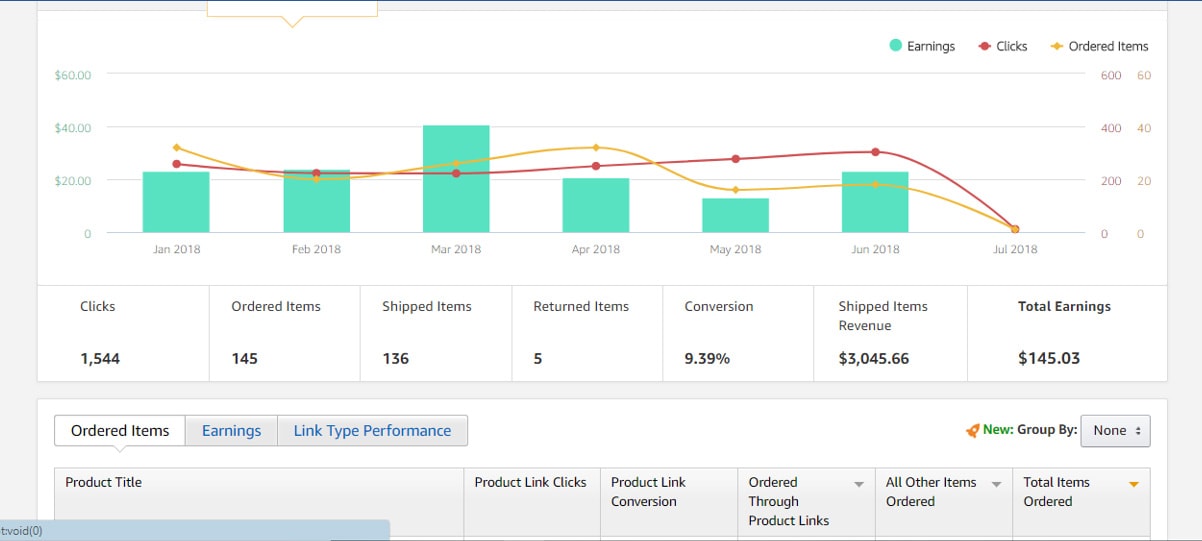
My abandoned website had netted a few $$$ while I was chasing Saudi riyals to take care of my family. You can imagine my surprise when I logged into my Amazon affiliate account and found that my website was still making some money even though I had not updated it for several months.
 |
| Click to view full image. |
By the time I started actively working on it again in May, it had lost a fair share of keyword rankings, but things kicked off again in June. I hope I'll be able to keep up with the writing.
Challenges in Getting Paid
This was one of those things that made me grit my teeth. How difficult can it be to get paid because you're living in Saudi Arabia?
You can imagine my excitement when I collected my very first cheque mailed from the US by Amazon. A few years back, I wouldn't have believed I could actually build a niche site and make money from it. But I finally had this sleek piece of paper with my name and address on it showing that I had earned $159 from referring people to Amazon.
My excitement died when I arrived at the female branch of my banking institution but I was asked to go to the male section because no one knew what to do with my cheque. At the male branch, the cheque caused a lot of commotion. People came of their offices to see this cheque from أمريكا--even the branch manager was called to see "the cheque."
Phones rang...a few persons were trying to find out what they were supposed to do with the cheque. Finally, a kind Saudi asked me to sit down and told me that banks do not accept cheques issued in US dollars.
Frustrated, I left the bank and decided to seek help from other Wealthy Affiliate members. Apparently, affiliates who lived in other countries such as Greece faced the same problem. It seemed banks won't accept cheques issued in US dollars because the US was trying to control the flow of its currency...whatever that meant. I just needed to cash my cheque.
A Wealthy Affiliate member who faced a similar issue advised me to contact Amazon and have them cancel the cheque and add the amount back to my balance in my affiliate account. Next, I had to sign up for a Payoneer account. Payoneer permits affiliates, freelancers, and other persons doing business online to have a virtual US bank account.
After signing up, I confirmed my identity and created my global account. Later on, I used my new virtual account on Amazon to be eligible for direct deposits. I also used my global bank account on ShareASale. During the next payout, the amount was transferred to my Payoneer account.
 |
| Click to view full image. |
Need your own Payoneer account?
SIGN UP FOR FREE HERE AND GET A $25 BONUS
I have now added my local bank to my Payoneer account. I plan to withdraw the amount to my local bank account once I make at least $1000. The withdrawal fee is low and you can view the transfer fee on Payoneer's website or within your Payoneer account. Some banks might charge a small fee for withdrawal. I don't know what my banking institution charges, but I'll try to find out.
My Take on Wealthy Affiliate
I’ve tried every affiliate marketing programme that you can think of, and I’ve lost a lot of money in my bid to make money from the comfort of my home. I’ve even joined programmes that permitted me to make only $3/month before I got mad and quit, and I would never recommend such programmes to anyone. At the end of the day, there’s only one that I can advise anyone to join: WealthyAffiliate® (WA).
Wealthy Affiliate®, in my opinion, is the number one programme that can teach anyone (from anywhere in the world) to make money online. I’m an active member of WA, so I’m speaking from the point of view of someone who has experienced this first hand. See a screenshot of the members’ area below:

These are some of the benefits of WA:
1. You can choose to sign up FREE and only upgrade to become a premium member when you wish to take your business to the next level. I generally advise those who sign up under me to use the free option for as long as they want before upgrading IF they see the potential of this programme. I, for example, signed up for a free membership and only upgraded after 2 years. It took me a while to understand the programme because I was skeptical in the beginning, having wasted too much time on other programmes that didn’t get me any closer to my goals.
2. There are so many resources in the members’ area, where you are taught how to make actual money online. Members are provided with tools, training, and videos to teach them how to build an online business. Members can also get support directly from the founders of the programme, Kyle and Carson.
3. Wealthy Affiliate® has an active community. I’ve never seen such an active community in other programmes that I’d joined online. Members are always quick to respond to questions when another member is experiencing difficulties in setting up their business. In other words, you get support all round the clock.
1. You can choose to sign up FREE and only upgrade to become a premium member when you wish to take your business to the next level. I generally advise those who sign up under me to use the free option for as long as they want before upgrading IF they see the potential of this programme. I, for example, signed up for a free membership and only upgraded after 2 years. It took me a while to understand the programme because I was skeptical in the beginning, having wasted too much time on other programmes that didn’t get me any closer to my goals.
2. There are so many resources in the members’ area, where you are taught how to make actual money online. Members are provided with tools, training, and videos to teach them how to build an online business. Members can also get support directly from the founders of the programme, Kyle and Carson.
3. Wealthy Affiliate® has an active community. I’ve never seen such an active community in other programmes that I’d joined online. Members are always quick to respond to questions when another member is experiencing difficulties in setting up their business. In other words, you get support all round the clock.
Ebook Publishing
You can make a pretty decent amount of money from ebook publishing. However, it does take a lot of work to write and publish a book. In addition to writing the book, you have to hire someone to edit and proofread it. Next, you need someone to write the blurb and another to design the cover.
If you don't have the budget, you can hire someone on Fiverr. You can find someone who's willing to edit and proofread a manuscript of 2000 to 5000 words for as little as $5. Once, you start making sales, you can hire an editor elsewhere for a more refined job.
I believe you can make more from self-publishing. Fortunately, the Internet has made this easier for us. Anyone, young or old, can write and publish a book. My favourite platforms are Amazon's KDP and Draft2Digital.
With Amazon's KDP, you have to hire someone to format your manuscript before uploading it to Amazon. If you can format the book yourself, fine. You get to save a few dollars.
It is much easier to use Draft2Digital. You can upload your Word document or an epub file, and Draft2Digital will distribute your book to several online book channels, including Amazon, Barnes & Noble, Kobo, Tolino, Scribd, Inktera, OverDrive, Playster, Apple, 24 Symbols, and Bibliotheca. All you need is one document to upload and Draft2Digital will do the rest.
Most of my income from ebook publishing comes from Draft2Digital, especially from Scribd. I don't make a lot from Amazon due to the high level of competition on that platform. If you have to get into ebook publishing, my advice is that you start with Draft2Digital, earn a few loyal readers, then move to Amazon.
You might not even need to get a KDP account to publish on Amazon because can submit your book to that channel on your behalf. But if you're writing in the self-help category, you'll have to submit your book yourself, as Amazon won't allow Draft2Digital to submit books in this category.
GET YOUR FREE DRAFT2DIGITAL ACCOUNT TODAY
Contrary to Amazon that offers direct deposit (US), gift cards, and cheques as the only payment methods, Draft2Digital offers more options. You can select direct deposit (both US and international), PayPal, Payoneer, or cheque, and Draft2Digital will transfer your royalties every month once your account reaches the payment threshold.
Other Ways of making Money Online in Saudi Arabia
Mystery Shopping
In mystery shopping, you’re contracted to pose as a “shopper”. You’ll purchase or use a service and give your feedback to the contractor at the end of your assignment. The contractor will refund (either in part or in whole) the amount that you spent during your “shopping” and pay you a small fee for your evaluation. While this might be a good way to earn extra cash, I don't believe anyone can make a living from this.
There’re a lot of scams out there, and you don’t want to lose money when your goal is to make it. Be wary of 'mystery shopping' programmes that ask you to pay a small fee (even if it is $10) to join.
One programme that I found interesting was that of International Service Check (ISC). Read more about what they do here. The members’ area looks like this (see the screen capture below) when you sign up, and you have to complete a certification process to be assigned checks for projects in one of the following areas: Jeddah, Riyadh, Madinah, Makkah, Al Ahsa, Taif, Dammam, Qassim, Tabuk, Jizan, Najran, or Yanbu. They typically send emails whenever they need service checkers at particular locations.

One programme that I found interesting was that of International Service Check (ISC). Read more about what they do here. The members’ area looks like this (see the screen capture below) when you sign up, and you have to complete a certification process to be assigned checks for projects in one of the following areas: Jeddah, Riyadh, Madinah, Makkah, Al Ahsa, Taif, Dammam, Qassim, Tabuk, Jizan, Najran, or Yanbu. They typically send emails whenever they need service checkers at particular locations.

They are legit and pay mystery shoppers when they complete their checks. However, you may have delays of up to 6 weeks before receiving your payment. One other downside of this programme is that if ISC isn’t satisfied with your evaluation, you won’t get paid. Imagine how distressing that can be—spending money as well as time and energy only for your evaluation to be qualified as ‘unsatisfactory’.
Direct Selling
I’ve tried EDMARK®, Avon® and Forever Living® and can proudly recommend these to women (and men) who have a business mind and who wish to make part-time income while hunting for a job. I personally know a few women who earn between 2000 and 5000 SAR/month just from promoting and selling Avon® products, and I’ve heard about other women who make up to 10000 SAR/month.
I'm a fan of EDMARK® products, and there're specific products such as Red Yeast Coffee, Ginseng Coffee, Shake Off Phyto Fiber, and Splina that I purchase nearly every month. EDMARK® has a very interesting referral programme where they offer incentives to members who have the highest number of referrals and sales. Hard-working members can even earn a car or a villa! And before you scream, I've personally met a Filipino who won a villa in Jeddah through their programme.
Online Services
If you’re good at writing or you have other skills that can be offered online, then there’re good chances you may be able to make some money with Fiverr®. If you don’t know it yet, Fiverr® is a marketplace that permits people to buy or sell their services (also called ‘gigs’) for $5. Here is a list of services that you can offer on Fiverr®:

· Writing and/or editing
· Graphic design
· Voice over
· Ebook formatting
· Book cover design
· Data entry
· SEO / SEM, etc.
Fiverr® is totally legit and they’ve been around since 2010. No worries...you get paid after each successful transaction, i.e., when your client is happy with the service you provided.
I hope you’ll be able to find something that works for you on this list. If there’re other programmes that you think can help expats in Saudi, please feel free to leave a comment below.
(Disclosure: Some of my links are affiliate links. This means that if you decide to upgrade, I shall be paid a small commission; however, I'd appreciate your support.)


